> For the complete documentation index, see [llms.txt](https://postman-v1.guides.gov.sg/llms.txt). Markdown versions of documentation pages are available by appending `.md` to page URLs; this page is available as [Markdown](https://postman-v1.guides.gov.sg/email-api-guide/programmatic-email-api/send-email-api/from-name-and-from-address.md).
# From Name and From Address
{% hint style="warning" %}
**Updated 26 September 2023:** Postman will no longer be onboarding any new programmatic email API users and create custom from addresses till further notice.
{% endhint %}
{% hint style="info" %}
**Updated 27 August 2024:** Postman's default sender email address has been changed from `donotreply@mail.postman.gov.sg` to `info@mail.postman.gov.sg`
{% endhint %}
## From Name vs From Address
The `from` field of an email contains **from name** and **from address**. This is illustrated in the image below:
Postman changed its default From Address from `donotreply@postman.gov.sg` to `info@postman.gov.sg` on 27 Aug 2024.
### API users using `info@postman.gov.sg` as their From Address
If the `from` field in the JSON body of the API call is omitted:
1. The from name defaults to `Postman.gov.sg`
2. The from address defaults to ``
### API users using `donotreply@postman.gov.sg` as their From Address
If your agency has **previously hardcoded** `donotreply@postman.gov.sg` and wish to continue using `donotreply@postman.gov.sg` as your From Address
* there is no code change thats needs to be done on your code base
* take note that your From Address **will still remain as** `donotreply@postman.gov.sg`
## Changing From Name
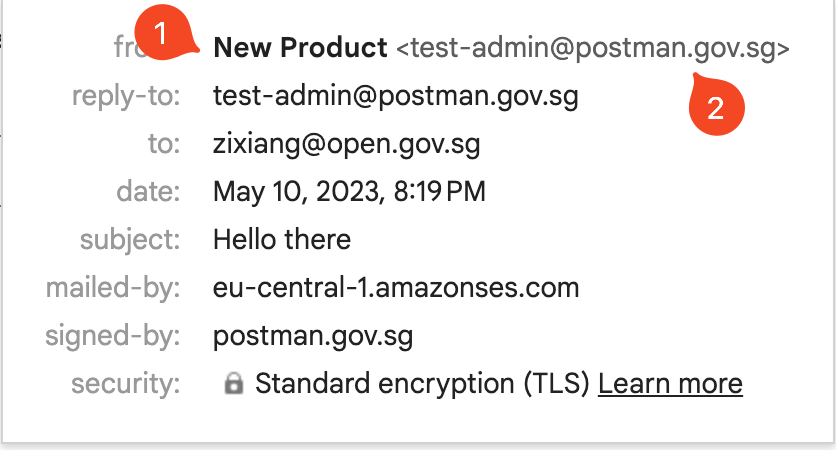
In our API, the from name of an email can be changed by the API user by modifying the `from` field in the API call. For example, to use `New Product` as the from name, the API user could use the following JSON body:
```json
{
"recipient": "zixiang@open.gov.sg",
"subject": "Hello there",
"body": "What's upppp",
"from": "New Product "
}
```
The email recipient will see the following:
For users that wish to customise their emails without going through the hassle of setting up a [custom from address](/email-api-guide/programmatic-email-api/custom-from-address.md), this is an intermediate solution used by our existing users.
## Using a Custom From Address
Users may wish to send emails using a custom from name as well as a custom from address (i.e. any email address that is not the default ``. Setting up a custom from address is necessary; for more information, [see here](/email-api-guide/programmatic-email-api/custom-from-address.md).
{% hint style="info" %}
Create an account on Postman using the email address from which you wish to send your email.
For example, if you want your email to be sent from `no-reply@agency.gov.sg`, you should log into Postman using this email address and generate your API keys on the dashboard.
{% endhint %}
To make use of the custom from address, the JSON body of the API call is:
```json
{
"recipient": "zixiang@open.gov.sg",
"subject": "Hello there",
"body": "What's upppp",
"from": "New Product "
}
```
The recipient will see:
1. A custom from name `New Product`
2. A custom from address ``